Key takeaways
- Day trading involves opening and closing positions within the same trading session, which avoids carrying positions overnight and can avoid overnight financing charges when positions are closed before the applicable rollover time.
- Day traders often rely on technical analysis, position sizing and predefined risk limits because short-term price movements can be fast and volatile.
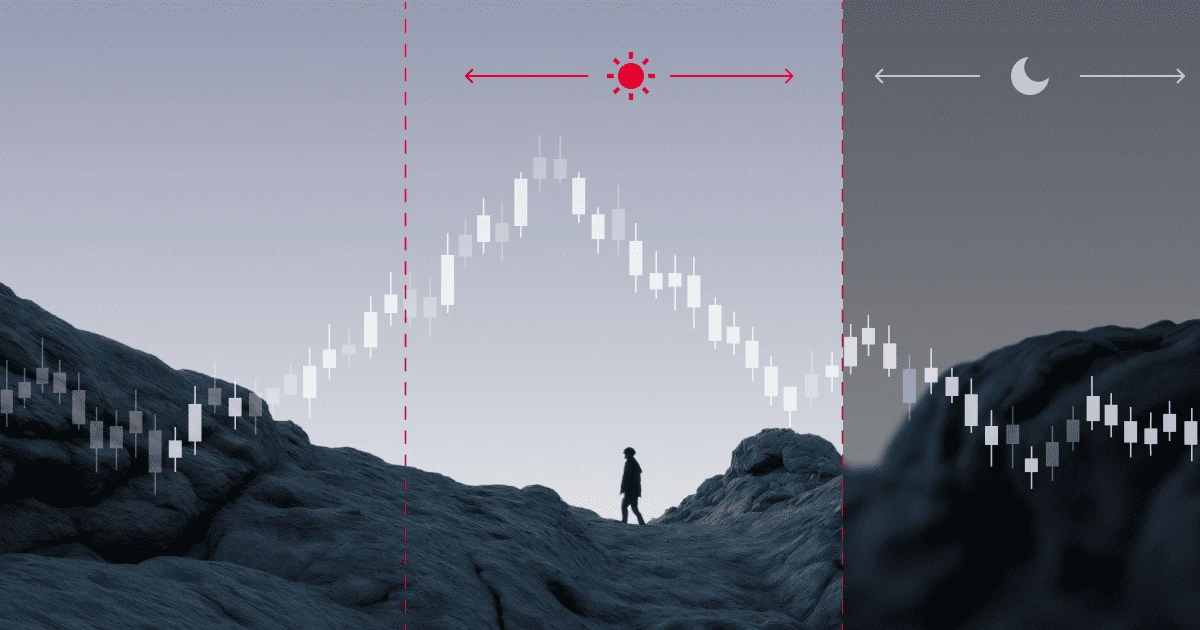
- Liquidity often increases around major market opens and during the London-New York overlap. Exact UTC times shift during the year because of daylight-saving changes.
Table of contents
- What is day trading?
- How does day trading work?
- Popular day trading strategies
- Essential technical analysis tools
- Risk management and capital requirements
- Advantages and disadvantages of day trading
- How to get started day trading
- Frequently asked questions
What is day trading?
Day trading involves buying and selling financial instruments within a single trading day, with holding periods ranging from seconds to hours. Day traders focus on short-term price movements and close their positions before the end of the trading session rather than holding them overnight.
Core characteristics of day traders
- They close positions before the end of the session to avoid overnight market exposure and, where applicable, overnight financing or swap charges.
- They generally look for actively traded instruments with enough intraday movement to create potential trading setups.
- They often use technical analysis. Even news-driven traders may use technical levels to plan entries, stop-losses and take-profit levels.
- Some day traders use leverage to gain larger market exposure from a smaller margin deposit. Leverage magnifies losses as well as gains, so risk controls are especially important.
Day trading vs. swing trading and position trading
| Feature | Day trading | Swing trading | Position trading |
|---|---|---|---|
| Holding horizon | Seconds to hours; positions are closed within the session | Days to weeks | Months to years |
| Primary analysis | Intraday technical analysis | Technical and fundamental analysis | Macro and fundamental analysis |
| Overnight exposure and swap | No, when all positions are closed before rollover | Yes | Yes |
| Execution and monitoring needs | Frequent monitoring and fast execution | Moderate monitoring | Less frequent monitoring |
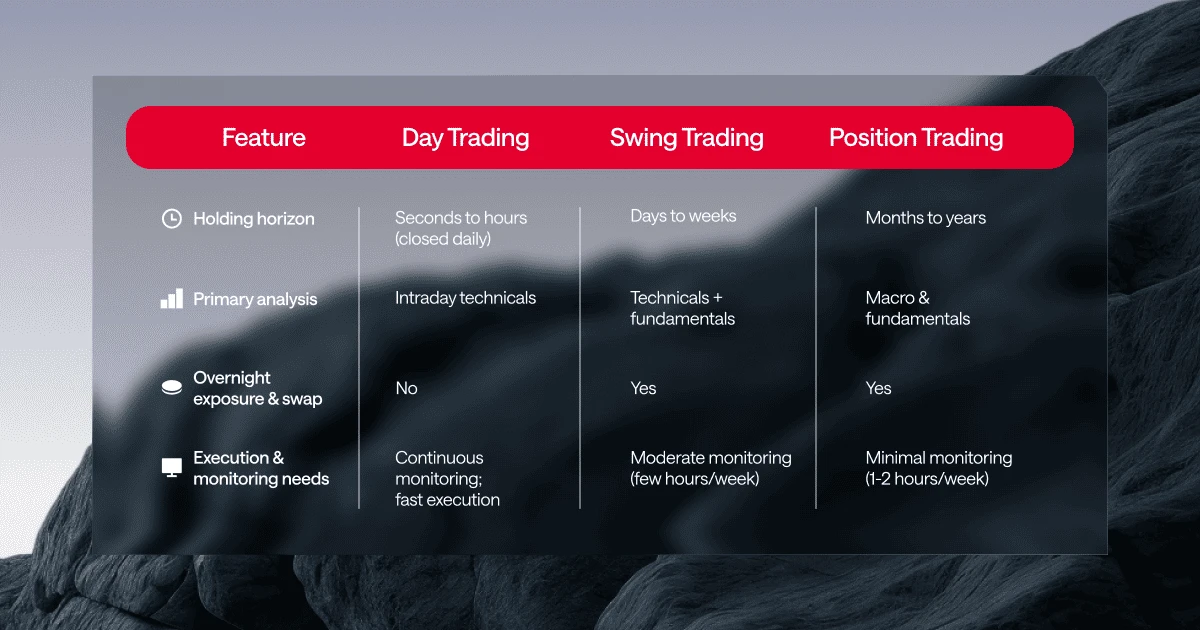
Compared with swing trading and position trading, day trading is more dependent on intraday price action and timely execution. The shorter timeframe can also make transaction costs, slippage and risk management more important to the overall result.
How does day trading work?
Asset classes you can day trade
Day trading can be applied to short-term price movements across a range of markets. On a CFD platform, examples include:
- Forex CFDs: Major, minor and exotic currency pairs trade across global sessions and can offer high liquidity, particularly in the most actively traded pairs. Spreads can vary with liquidity and volatility. Learn more about spreads.
- Share and index CFDs: Equity indices and individual shares can react sharply to earnings, company news and economic releases.
- Commodity CFDs: Instruments such as crude oil, gold and silver can experience intraday moves around macroeconomic data, supply developments and geopolitical events.
- ETF and equity-related CFDs: These can provide exposure to sectors, themes or groups of underlying assets, depending on the instruments available through the broker.
- Cryptocurrency markets: Short-term trading can also involve crypto CFDs, perpetual futures and spot crypto. On Axi's international offering, product availability depends on the platform, account and region, and trading conditions differ between CFDs, perpetuals and spot markets.
Market hours and session overlaps
Trading activity and liquidity often increase around major market opens and when large sessions overlap. In forex, the London-New York overlap is one of the busiest periods. The exact UTC window changes during the year because the UK and US switch between standard time and daylight-saving time on different dates.
Manual trading vs. automated trading
Manual trading requires the trader to monitor markets, decide when conditions meet the trading plan and place or manage orders directly.
Automated trading uses algorithms or Expert Advisors (EAs) to monitor predefined conditions and submit or manage orders according to a rules-based strategy. This is different from institutional high-frequency trading, which typically relies on specialised low-latency infrastructure and very high order volumes.
Popular day trading strategies
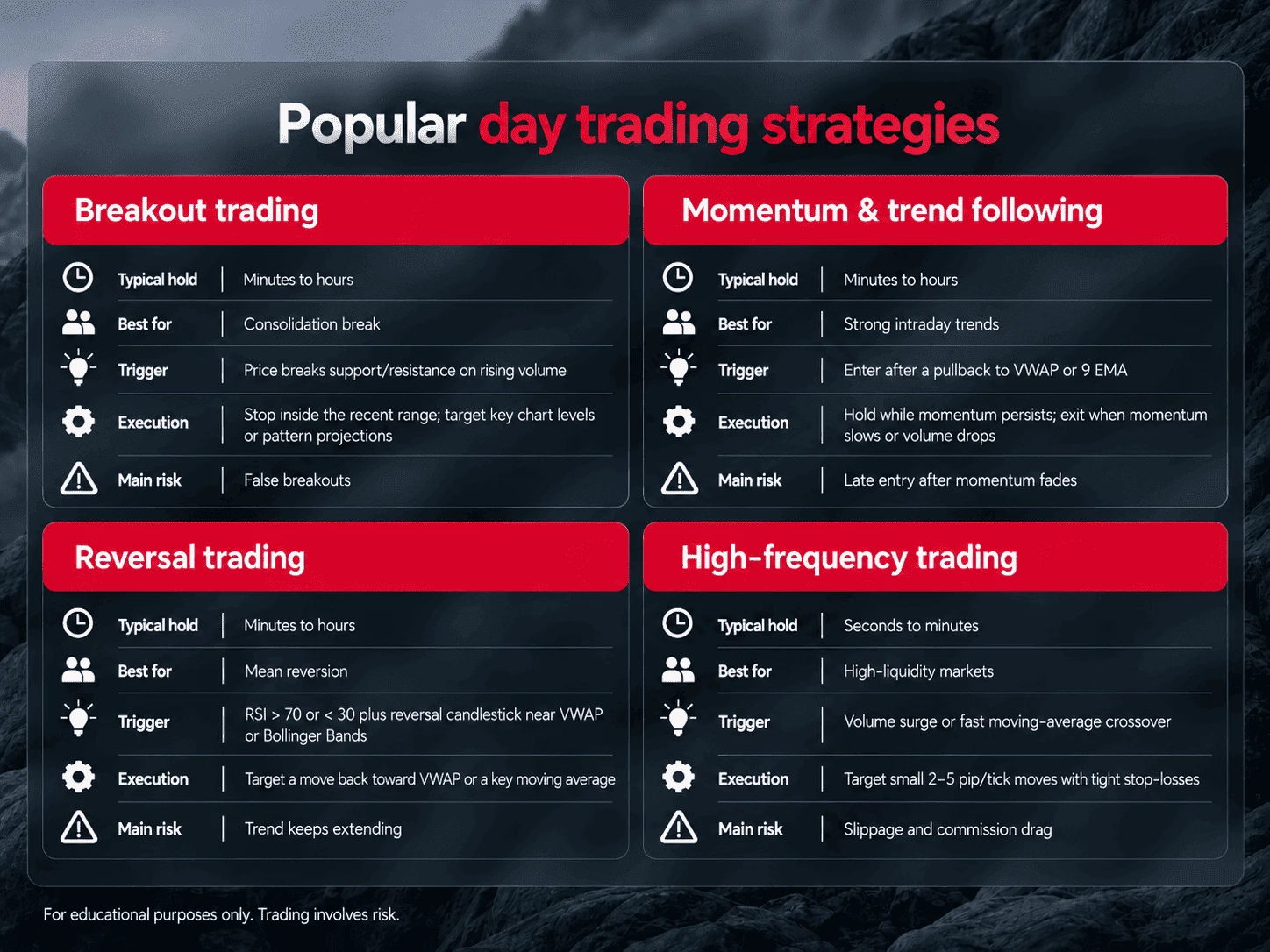
Day traders use different approaches depending on market conditions, time horizon and risk tolerance. Four commonly discussed approaches are outlined below.
Breakout trading
Breakout strategies look for price moving beyond an established support or resistance area after a period of consolidation.
Setup: Identify support and resistance boundaries that have been tested repeatedly.
Trigger: A trader may look for price to move above resistance or below support, sometimes with rising volume or another confirmation signal.
Execution: A stop-loss can be placed back inside the recent range to define risk if the breakout fails. Potential exits may be based on nearby chart levels, a fixed risk-to-reward framework or another predefined rule.
Momentum and trend following
Momentum strategies focus on strong intraday moves that may be driven by news releases, earnings announcements, economic data or sustained order flow.
Setup: Screen for instruments showing elevated volume, volatility or a clear directional move.
Trigger: Some traders wait for a pullback toward a dynamic reference level such as VWAP or a short-term exponential moving average (EMA).
Execution: The position is managed while the trend remains intact, with predefined exit criteria if momentum weakens, volume fades or the price structure breaks down.
Reversal trading (mean reversion)
Reversal strategies look for prices that have moved a significant distance from a recent average and may revert toward a more central level.
Setup: Monitor stretched price moves using oscillators, volatility bands and nearby support or resistance.
Trigger: Traders may combine an overbought or oversold reading, such as RSI above 70 or below 30, with price-action confirmation near VWAP, Bollinger Bands or another reference level. An RSI threshold alone does not guarantee a reversal.
Execution: The trade is taken against the recent move, with risk defined beyond the invalidation level and an exit planned near a central reference level or other predefined target.
High-frequency trading
High-frequency trading (HFT) is an automated form of very short-term trading that uses algorithms, rapid data processing and low-latency execution to place and cancel large numbers of orders over extremely short timeframes. It is generally associated with professional or institutional firms rather than discretionary retail traders.
Retail scalping can also involve very short holding periods, but it is not the same as HFT. Scalpers may use seconds-to-minutes holding periods and focus on liquidity, spreads, execution speed and transaction costs, while true HFT typically requires specialised infrastructure and automated order-management systems.
Essential technical analysis tools for day traders
Day trading strategies often use technical indicators and price levels to define market conditions, entries, exits and risk. Common examples include:
Volume-weighted average price (VWAP)
VWAP calculates the average price at which an asset has traded during the session, weighted by volume. Traders may use the relationship between price and VWAP as one way to assess whether current trading is occurring above or below the session's volume-weighted average, but it should not be treated as a standalone signal.
Key moving averages (9 EMA, 20 EMA and 200 SMA)
Moving averages smooth price data to help traders identify trend direction. Shorter exponential moving averages such as the 9 EMA and 20 EMA respond more quickly to recent price changes and are often used to track short-term momentum. The 200-period simple moving average (SMA) provides a longer-term reference level for the timeframe being analysed.
Support, resistance and key price levels
Support and resistance are areas where buying or selling interest has previously affected price movement. Traders use these levels to plan entries, exits and invalidation points, while recognising that price can break through them.
Relative strength index (RSI) and oscillators
The RSI is a momentum oscillator that ranges from 0 to 100. Readings above 70 are commonly described as overbought and readings below 30 as oversold, but these conditions can persist during strong trends. Traders therefore often combine RSI with price action, trend context or other indicators rather than assuming that a reversal is imminent.
Risk management and capital requirements
A clear trading plan and defined risk controls are important in day trading because leverage, frequent trading and fast market conditions can increase losses quickly.
The 1% risk guideline and position sizing
A commonly used risk-management guideline is to limit the amount at risk on a single trade to a small percentage of account equity, such as 1%. This is a rule of thumb rather than a universal requirement, and the appropriate limit depends on the trader's circumstances and risk tolerance.
Example: On a $10,000 account, a 1% risk limit would equal $100 of maximum planned risk on one trade.
A simple position-sizing framework is:
Risk amount = Account equity × chosen risk percentage
Position size = Risk amount ÷ stop distance per unit
Example: If a trader is willing to risk $100 on an instrument priced at $50 with a stop at $48, the stop distance is $2 per unit. Dividing $100 by $2 gives a position size of 50 units, before allowing for transaction costs or slippage.
For forex, indices, commodities and other CFDs, position sizing also needs to account for the instrument's contract specification, pip or tick value and currency conversion where relevant.
Essential order types: stop-loss, trailing stop and take-profit
A stop-loss order instructs the broker to close a position when a specified stop level is reached. Standard stop orders are not guaranteed to fill at the exact stop price, so slippage can occur during fast or illiquid markets.
A trailing stop is a stop-loss that can move automatically as the market moves in the position's favour, according to the distance or rule selected by the trader.
A take-profit order is used to close a position at a predefined target price if that level is reached.
Managing drawdown and avoiding overtrading
In addition to controlling the risk on an individual trade, some traders set a maximum daily loss or drawdown limit. For example, a trader might choose to stop trading after losing 2% to 3% of account equity in one day. The specific threshold is a personal risk-control decision, not a universal standard.
A daily limit can also help prevent impulsive attempts to recover losses through revenge trading. Reviewing trading losses after the session can be more useful than increasing risk in response to them.
Leverage, margin and account conditions
Leverage and margin requirements are not the same across every instrument, account or platform. Higher leverage reduces the margin needed to open a position but also increases the speed at which gains and losses can build relative to the trader's account balance.
On Axi's international offering, maximum leverage and margin requirements vary by product, account type, platform and client eligibility. Traders should check the current product schedule, account terms and applicable legal documents before opening a leveraged position rather than assuming that one leverage ratio applies to every market.
Advantages and disadvantages of day trading
Potential advantages
- No overnight market exposure: Closing positions within the trading session reduces exposure to overnight price moves and gaps.
- No overnight financing when closed before rollover: Positions that are closed before the broker's applicable rollover time generally do not incur overnight swap or financing charges.
- Frequent setups: Day trading strategies can produce multiple potential setups within an active session.
- Defined trading windows: Some traders focus on specific periods such as major market opens or session overlaps rather than monitoring every market throughout the day.
- Choice of markets: Day trading techniques can be applied across different instruments, provided there is enough liquidity and movement for the strategy being used.
Potential disadvantages
- High risk: Fast markets, leverage and short decision windows can lead to rapid losses.
- Transaction costs: Frequent trading means spreads, commissions and slippage can accumulate quickly and materially affect results.
- Risk of overtrading: Constant intraday price movement can tempt traders to take low-quality setups or increase activity after a loss.
- Stress and time commitment: Monitoring markets and making repeated decisions under time pressure can be demanding.
- Steep learning curve: Short-term trading requires discipline, execution consistency and the ability to follow a risk plan during volatile conditions.
How to get started day trading
Step 1: Select a trading platform and broker
Key considerations include:
- Legal entity and client protections: Check which legal entity will provide the account, its registration or regulatory status, the dispute-resolution arrangements available to clients and the legal documents that apply.
- Execution and pricing: Review spreads, commissions, order execution and the potential effect of slippage during fast markets.
- Platform: Check whether the available platform supports the charts, order types and automation tools required by the strategy. Axi currently offers MetaTrader 4, MetaTrader 5 and the Axi Trading Platform on its international site.
- Market access: Confirm that the instruments and order types needed for the strategy are available under the relevant account and jurisdiction.
Step 2: Practise strategy execution on a demo account
A demo account can be used to practise order placement, test a strategy and assess whether actively monitoring markets for extended periods fits the trader's routine.
Demo accounts operate in a simulated market environment. Performance in a demo account may differ from performance in a live trading account.
Step 3: Build a personal trading plan and journal
A trading plan should define the setup, entry conditions, exit rules, maximum risk and the circumstances in which no trade should be taken. Testing the plan in a simulated environment can help identify which instruments and market conditions are suited to the approach.
Step 4: Move to live trading with defined risk controls
Live trading introduces real financial risk, slippage and emotional pressure that cannot be fully reproduced in a demo environment. If a trader chooses to move to live markets, position size, stop placement and daily risk limits should be defined before the trade is opened, and performance should be reviewed before increasing exposure.
Axi Market Analyst Milan Cutkovic says:
"Day trading is a different game from swing trading. Swing trading gives a trade more room to develop, while day trading demands much more time, discipline, and emotional control. From my experience, it's not about being right every day; it's about following your process and managing risk consistently. It's time-intensive and not for everyone, but if you treat it like a profession rather than a shortcut, the results can follow."
This information is not to be construed as a recommendation; or an offer to buy or sell; or the solicitation of an offer to buy or sell any security, financial product, or instrument; or to participate in any trading strategy. It has been prepared without taking your objectives, financial situation and needs into account. Any references to past performance and forecasts are not reliable indicators of future results. Axi makes no representation and assumes no liability with regard to the accuracy and completeness of the content in this publication. Readers should seek their own advice.
FAQs
While account registration has no minimum deposit threshold, funding a live trading account requires a minimum initial deposit of $5 (or currency equivalent), depending on the selected payment method. To trade sustainably, account holders should maintain sufficient capital beyond the minimum deposit to meet margin requirements and prevent automated margin close-outs.

Axi Team
The Axi team brings together specialists with decades of experience across every major financial sector. As authors of our expert articles and trading guides, we share insight into forex education, the stock market, and commodities. We use this collective knowledge to provide the practical perspective needed to navigate the markets effectively.