What is trading?
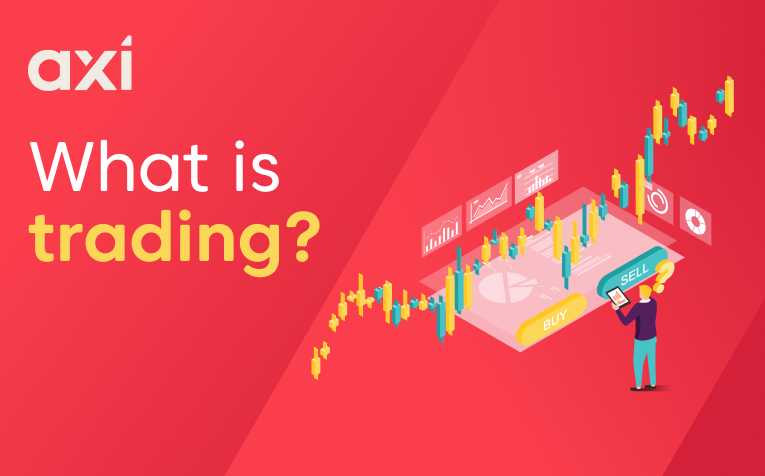
Trading involves buying and selling various financial instruments including stocks, bonds, currencies, commodities, and cryptocurrencies. It can be done by a wide range of market participants from small retail traders to large hedge funds and central banks. Generally, the aim of trading is to make a profit, although some market participants might enter transactions for the purpose of hedging.
There are several types of financial instruments used by market participants. For example, currencies can be traded by using contracts for difference (CFDs), which are immensely popular amongst retail traders. There are products such as FX forwards and swaps, which are also currency-related products but are more frequently used by institutional rather than retail traders.
How does trading work?
To understand how trading works, you must first understand its mechanics. If you buy an asset and sell it at a higher price than you bought, you have realised a profit. On the other hand, if you are forced to sell it at a lower price than you bought, you will realise a loss.
To access markets, you will first need to open a trading account with a broker. Brokers act as intermediaries between buyers and sellers and provide traders with a trading platform on which they can place their orders. Brokers send those orders to an exchange or market makers, depending on the asset and type of instrument being traded.
As competition has become fiercer, brokers started to offer their clients more resources such as trading tools and educational materials, which are often free of charge. They may also produce research and market analysis that can help their clients to make better decisions.
Brokers provide margin trading, an important feature for many retail traders, as it allows them to open far larger positions than their account balance would usually allow. This can amplify both profits and losses.
Trading platforms have become a valuable tool, as they allow traders to use expert advisors (EAs) and other automated trading tools.
Assets and markets to trade
1. Forex (currencies)
The currency market is the biggest decentralised global market in the world that is operating 24/5. Traders can access a wide range of currencies from major to minor and exotic currencies. The most popular currency pair traded, measured by trading volume, is EUR/USD. Most of the trading is happening on the spot market, but traders also use FX derivatives such as options, forwards, and swaps.
2. Stocks
The shares of publicly listed companies are available to trade on the stock market. An example of this is the NYSE (New York Stock Exchange), where major companies such as Apple, Microsoft, and Nvidia are listed. Stocks can be traded in the form of physical shares (the trader receives actual shares) or as CFDs (the trader does not own any actual shares and just speculates on the price movement of the stock).
3. Bonds
Bonds include debt securities issued by governments, corporations, and municipalities. The US bond market is the biggest in the world, and the US 10-Year Treasury is one of the most watched debt securities.
4. Commodities
The commodities market is where various commodities such as oil, precious metals, agricultural products, and industrial metals are traded. Trading is done both over the counter (OTC) and on regulated and centralised exchanges such as the Chicago Mercantile Exchange (CME). The most widely used type of instrument is futures contracts.
5. Cryptocurrencies
The cryptocurrency market is a digital market where cryptocurrencies are exchanged. Trading occurs both on centralised exchanges such as Binance and Coinbase and decentralised exchanges that allow peer-to-peer trading. Recently, cryptocurrency ETFs have emerged, which are listed on major stock exchanges. With Axi you can trade Crypto CFDs, Perpetual Futures or Buy Crypto for long-term investment.
Types of trading styles
While there are plenty of trading strategies and approaches to trading, we generally differentiate between four types of trading:
- Position trading: Position trading involves holding positions for an extended period, which could be weeks, months, or even years. Position traders typically use fundamental analysis and try to profit from long-term market trends, but they may also incorporate technical analysis, particularly for identifying take profit and stop loss orders. Position traders generally require a lot of patience and discipline.
- Swing trading: With swing trading, positions are usually held for days or weeks. It is called swing trading because traders try to capture swings in the market, i.e., buying at a swing low and selling at a swing high, and vice versa. While swing traders can use fundamental analysis, technical analysis is more common, particularly for identifying entry and exit points.
- Day trading: As the name suggests, the main characteristic of day trading is that all positions are closed before the end of the day. Day traders engage in short-term trading, although the number of trades they take can vary widely. While some day traders only place a few trades per day, some may place dozens. Day trading requires more time and dedication, and traders will often have to schedule their day around key market events.
- Scalping: This trading style involves holding positions briefly, from seconds to minutes. Scalpers are aiming to capture small price movements and profit from those. Scalping is very time-intensive and requires a high level of concentration.
Example of a trade
Let´s start with an example of a share CFD trade:
Microsoft is trading at $403.00 / $403.50. This means you can buy Microsoft at $403.50 and you can sell it at $403.00.
Let's assume you buy 1 Microsoft CFD at $403.50, anticipating that it will reach $415 later in the day.
Outcome A: Microsoft shares rise
Microsoft reaches the $415 level, and you decide to book the profit by closing your position (i.e., selling). You bought Microsoft for $403.50 and sold it for $415, netting you a profit of $11.50.
Outcome B: Microsoft shares tank
Unfortunately, some bad earnings figures have led to a sell-off in Microsoft, and it hit your stop-loss order at $395. You bought Microsoft at $403.50 and sold it at $395, which means you realized a loss of $8.50 on this position.
Now, let´s look at an example of a forex trade:
Suppose you believe the euro (EUR) will go up against the US dollar (USD).
You decide to buy 10,000 units of the EUR/USD currency pair at the current exchange rate of 1.1000. The total size of your CFD trade position will be:
10,000 EUR x 1.1000 = $11,000
Now that your trade is open, let’s say the EUR/USD exchange rate rises to 1.1200 and you decide to close your trade position. At that point, the difference between the opening and closing exchange rates is 0.0200 (1.1200 – 1.1000). You traded 10,000 units, so your profit calculation looks like this:
0.0200 x 10,000 = $200
Because the value of the EUR has gone up, you make a $200 profit.
However, if the exchange rate had moved against your prediction, you would have incurred a loss. For example, if the price of EUR went down from 1.1000 to 1.0900 (a 0.0100 difference), your loss would be calculated as follows:
0.0100 x 10,000 = $100
How would it work for oil trading?
USOIL is trading at 78.50 / 78.53. You anticipate that oil prices will rise to 78.90 by the end of the day, and therefore you buy 1 USOIL contract at 78.53.
Outcome A: You correctly anticipated an intraday rally in USOIL and closed your long position at $78.90. If you trade 1 lot of USOIL, every $0.01 price move is worth $0.10 in profit or loss. The difference of 37 cents, therefore, nets you a profit of $3.70.
Outcome B: You were wrong, and the position moved against you, triggering your stop loss order at $78.20. The price difference of 33 cents caused you a loss of $3.30.
Trading vs investing
Trading and investing have the same end goal — to generate a profit. However, there are several key differences:
- Time: Traders are typically holding short-term positions, ranging from seconds to days. Investors on the other hand are in for the long run and could hold positions even for decades.
- Frequency: Investors may place a few transactions per month or even per year. On the other hand, a trader may place a hundred transactions in a single day.
- Goals: Investors generally plan long-term and may consider things like retirement, inheritance, and long-term tax planning. Traders are trying to profit from short-term price fluctuations.
- Risk appetite: Trading is a risky activity, and naturally traders will have a higher risk appetite than investors, who are typically more conservative and seek lower risk.
- Analysis: Investors generally focus on fundamentals and long-term trends. For example, an investor may buy an ETF based on India’s stock market with the expectation that its economy will rapidly grow in the next 2-3 decades. Traders on the other hand are more likely to use technical analysis.
- Leverage: Traders frequently make use of leverage, opening positions far larger than they could normally do with their balance. With investors, the use of leverage is less prevalent.
How to trade for a living
A question that many traders, especially beginners, ask is – is it possible to trade for a living? Yes, it is, although one should be prepared for a long and challenging journey. It not only requires time but also patience and dedication. Markets evolve quickly, and even a successful strategy could eventually stop working, forcing you to adapt.
Before embarking on this journey, it is important to set realistic goals and milestones. If you are in for the long run, you should not aim at high returns in the beginning or put yourself under too much pressure. Demo accounts are useful as they allow you to practise without risking real money, and joining an online community can be very useful for exchanging ideas with fellow traders.
At some point in your journey, you may consider joining a prop trading program. Capital is something that many traders struggle with, and that is why capital allocation programs can be extremely useful. They also help you be more disciplined, as there are set rules, for example for the maximum drawdown you can hit.
With prop trading programs, it is not about getting rich quickly or generating lots of profits in a short period of time, but rather about consistency and turning your passion into a career.
There are several reasons becoming a full-time trader is attractive to so many:
- Independence: Being an independent full-time trader you only report to yourself, and you can structure your day and working hours. For example, scalpers might only dedicate 4 hours per day to trading and use the rest of the day to learn and improve their skills.
- Potential profit: As an independent full-time trader, and being able to fully dedicate yourself to trading, the potential for generating profits is rising, and the upside is unlimited.
- Career pathway: Joining a prop trading program could drastically change your trading career as it allows you to gain access to capital. While you give up some of your autonomy due to the rules and restrictions of the program, you will still be an independent trader.
Advantages of trading
Trading keeps attracting many people due to its potential for high returns. The use of leverage allows many retail traders to control larger positions than they normally could. While this amplifies potential profits, it does the same for potential losses, which makes trading risky.
Trading has evolved rapidly within the past two decades and there is a low barrier to entry. There are many brokers competing in the industry, bringing down costs and minimum deposit requirements. All that is needed to get started today is a mobile phone, an internet connection, and a small amount of funds.
The rapid growth of the trading industry has also led to the evolution of trading platforms. They have become more sophisticated and there are many tools now available to traders, often free of charge.
The growing popularity of trading led to large online communities where traders share their views, ideas, and even tools such as expert advisors. Copy trading has also become popular, enabling traders who do not have time to follow markets, or create a strategy, to participate by copying others.
Disadvantages of trading
Trading is risky as markets can be extremely volatile, which could lead to significant losses in a brief period.
Leverage is commonly used in trading, and while it can amplify profits, it also increases losses, with the risk of losing more than was invested.
Furthermore, trading requires constant learning and adapting, as market conditions change, and strategies stop working.
Emotions are another major hurdle that traders face. In investing, it is easier to stomach a sell-off in the stock market if one is planning to keep the investment for multiple decades. Meanwhile, traders are forced to make fast decisions at times and constantly monitoring the market and news can make them easily doubt their decisions.
Conclusion
Trading describes buying and selling financial instruments with the goal of profiting from price fluctuations. It has become easily accessible with little more than a mobile phone, an internet connection, and the small amount of capital needed to get started. Traders today have access to a wide range of educational materials, online communities, and tools — often for free.
To get started, you need a trading account with a broker. Brokers offer a trading platform on which you can place orders, analyse charts, and monitor prices and the news.
While trading comes with significant risk, it keeps attracting people due to the profit potential and ease of access.
Ready to trade your edge?
Join thousands of traders and trade CFDs on forex, shares, indices, commodities, and cryptocurrencies!
This information is not to be construed as a recommendation; or an offer to buy or sell; or the solicitation of an offer to buy or sell any security, financial product, or instrument; or to participate in any trading strategy. It has been prepared without taking your objectives, financial situation, or needs into account. Any references to past performance and forecasts are not reliable indicators of future results. Axi makes no representation and assumes no liability regarding the accuracy and completeness of the content in this publication. Readers should seek their own advice.

Milan Cutkovic
Milan Cutkovic is an experienced trader and market analyst specializing in forex, indices, commodities, and stocks. He was one of the first traders accepted into the Axi Select program, which identifies talented traders and supports their professional development.
He is passionate about helping others improve their trading skills through educational articles, eBooks, and content published on the Axi blog. His work is regularly featured and quoted in major international media outlets, including Yahoo Finance, Business Insider, Barron's, CNN, Reuters, New York Post, and MarketWatch.